


Light Sensors Market 2034 | Industry Size, Share & Growth Analysis
- Pallavi Garudkar
- Feb 16
- 3 min read

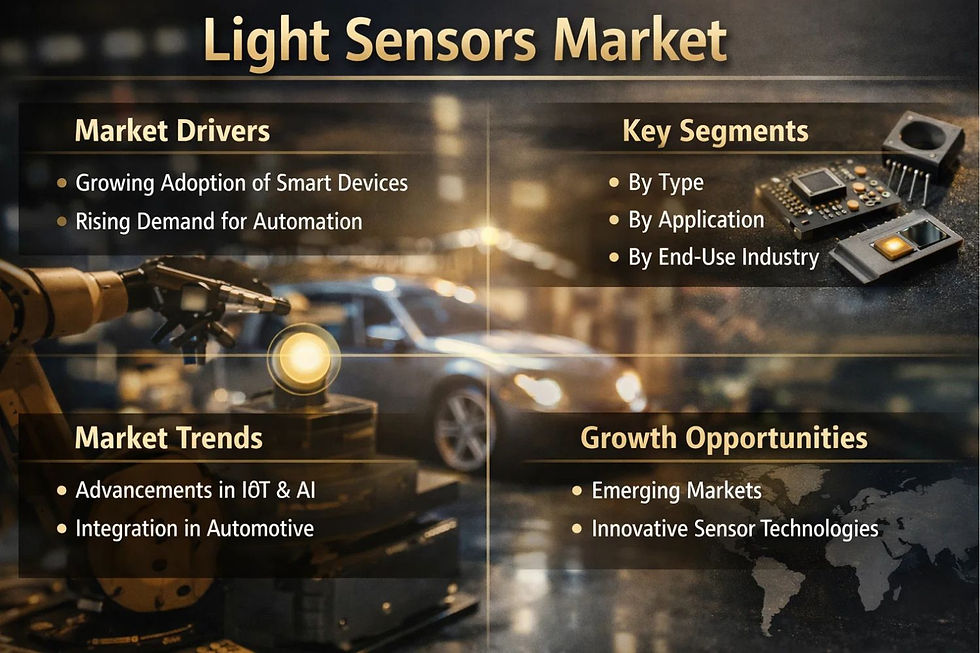
According to Fortune Business Insights the global light sensors market size was valued at USD 4.89 billion in 2025. The market is projected to grow from USD 5.44billion in 2026 to USD 12.82 billion by 2034, exhibiting a CAGR of 11.30% during the forecast period. The light sensors market comprises devices that detect light intensity and convert it into electrical signals for measurement, monitoring, and control. These sensors — including photodiodes, phototransistors, CMOS and CCD image sensors, photoconductive cells, and infrared light sensors — are widely used across consumer electronics, automotive, healthcare, industrial automation, smart cities, and IoT applications.
As technology advances and adoption of automated, connected systems grows, the demand for accurate and energy-efficient light sensing technologies continues to expand. Key market drivers include rising smartphone penetration, demand for smart lighting, autonomous vehicles, and broader industrial digitization.
Get a Free Sample PDF Brochure: https://www.fortunebusinessinsights.com/enquiry/request-sample-pdf/light-sensors-market-114172
Market Dynamics
Drivers
Smart Device Proliferation: Rapid growth in smartphones, tablets, wearables, and smart appliances fuels demand for light sensors.
Automotive Electronics Adoption: Light sensors enhance safety and automation features in vehicles.
Energy Efficiency & Smart Lighting: Demand for light sensors rises with smart lighting and energy management systems.
Industrial Automation: Rising factory automation, robotics, and sensing accuracy requirements.
Healthcare Technology Integration: Use of optical and light sensing in medical diagnostic equipment.
Restraints
Environmental Sensitivity: Light sensors can be affected by external factors like temperature and dust, requiring advanced calibration and protection.
High Integration Costs: Manufacturing costs for sophisticated sensor technologies can be higher, especially for advanced automotive and medical applications.
Component Miniaturization Challenges: Balancing performance with size constraints in compact devices can be challenging.
Market Segmentation Analysis
By Sensor Type
Photodiode Sensors
Phototransistor Sensors
CMOS Image Sensors
CCD Image Sensors
Photoconductive Cells
Optical Sensors
Other Light Sensors
Photodiode and CMOS image sensors dominate due to their high sensitivity, integration capability, and suitability for a wide range of applications.
By Technology
Ambient Light Sensors
Proximity Light Sensors
Infrared (IR) Light Sensors
Laser Light Sensors
Other Technologies
Ambient and proximity light sensors hold significant share, especially in consumer electronics and smart lighting applications.
Competitive Analysis
The global light sensors market is competitive with several established semiconductor and sensor manufacturers alongside emerging technology innovators. Competitive differentiation is driven by sensor performance, miniaturization, power consumption, integration flexibility, and partnerships with electronics and automotive OEMs.
Competitive strategies include:
Investments in R&D for next-generation sensing technologies
Strategic collaborations with device manufacturers
Expansion of global production capacities
Development of tailored solutions for key verticals like automotive and healthcare
Key Players
Major companies active in the global light sensors market include:
ams OSRAM AG (Germany)
STMicroelectronics N.V. (Switzerland)
Broadcom Inc. (U.S.)
Vishay Intertechnology Inc. (U.S.)
Sharp Corporation (Japan)
Analog Devices, Inc. (U.S.)
Everlight Electronics Co., Ltd. (Taiwan)
Texas Instruments Inc. (U.S.)
ON Semiconductor (onsemi) (U.S.)
ROHM Co., Ltd. (Japan)
Key Industry Development:
September 2025 – Philips introduced MotionAware, a new feature that converts smart bulbs into motion sensors via radio-frequency (RF) sensing. This removes the requirement for standalone motion hardware, enhancing automation and privacy within smart home lighting systems.
June 2025 – Sony Semiconductor Solutions revealed the IMX479 stacked SPAD depth sensor for automotive LiDAR use that has 520 dToF pixels and can detect up to 300 meters. The sensor is aimed at advanced driver assistance systems and autonomous driving uses, with sample shipments starting in Autumn 2025 for JPY 35,000 (USD 230) per unit.
Get Your Customization Research Report:
About Us:
Fortune Business Insights™ delivers accurate data and innovative corporate analysis, helping organizations of all sizes make appropriate decisions. We tailor novel solutions for our clients, assisting them to address various challenges distinct to their businesses. Our aim is to empower them with holistic market intelligence, providing a granular overview of the market they are operating in.
Contact Us:
Fortune Business Insights Pvt. Ltd.
9th Floor, Icon Tower,
Baner - Mahalunge Road, Baner,
Pune-411045, Maharashtra, India.
Phone:
US: +18339092966
UK: +448085020280
APAC: +91 744 740 1245Email: sales@fortunebusinessinsights.com



Comments